Paver Driveways: Costs, Patterns, Pros and Cons — the Full Breakdown
By Noah James
• 8 min read • Founder, DrivewAI
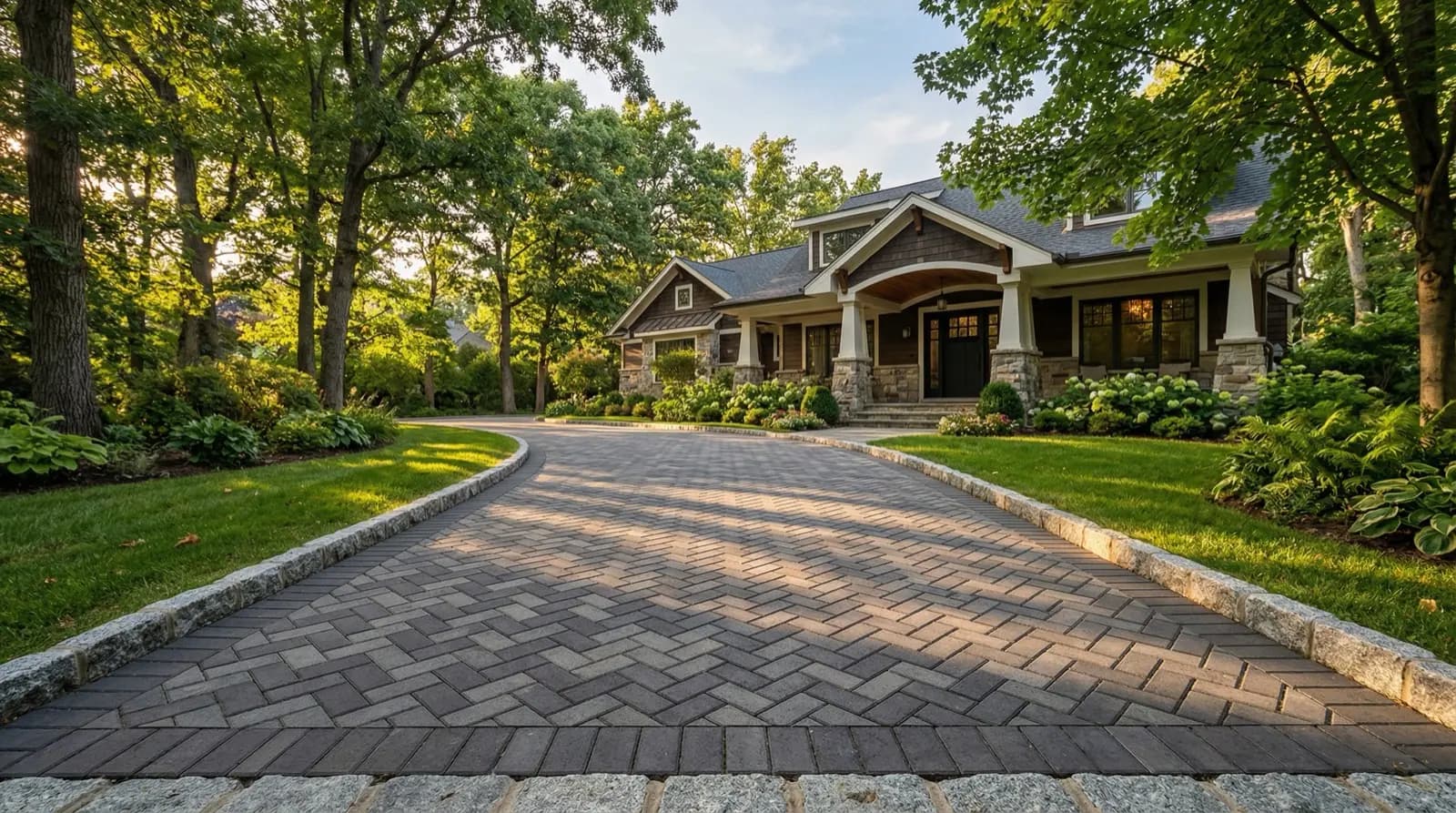
Paver driveways are the most polarizing option in the driveway world. Advocates will tell you they're the absolute best surface money can buy. Critics will tell you they're overpriced, high-maintenance, and prone to weeds. The truth, as usual, sits somewhere in between.
After looking at real installation data and talking to both contractors and homeowners, here's the unvarnished reality of paver driveways.
What Paver Driveways Actually Cost
Forget the ranges you see on generic home improvement sites. Here's what homeowners are actually paying in 2026, based on data from Angi's contractor marketplace and HomeAdvisor project tracking:
Standard interlocking concrete pavers: - Material only: $4-$10/sq ft - Installed (including base): $15-$25/sq ft - 600 sq ft driveway, installed: $9,000-$15,000
Premium concrete pavers (tumbled, textured, or large-format): - Installed: $20-$30/sq ft - 600 sq ft driveway: $12,000-$18,000
Clay brick pavers: - Installed: $18-$28/sq ft - 600 sq ft driveway: $10,800-$16,800
Natural stone pavers (bluestone, travertine, granite): - Installed: $25-$50/sq ft - 600 sq ft driveway: $15,000-$30,000
These prices include demolition of the existing surface, base preparation (typically 6-8 inches of compacted aggregate), edge restraints, sand bedding, paver installation, polymeric sand, and compaction. If your existing base is in good condition and doesn't need full replacement, costs drop by roughly 15-20%.
Patterns: More Than Aesthetics
The pattern you choose isn't just decorative — it affects the driveway's structural performance under vehicle loads.
Herringbone (45° or 90°): The gold standard for driveways. The interlocking angles distribute weight across multiple pavers, preventing individual units from shifting under tire loads. The Portland Cement Association recommends herringbone as the preferred pattern for any vehicular application. It's also the most visually interesting, with the angled lines creating depth and movement.
Running bond: Pavers laid in offset rows, like a brick wall. It's simpler to install (and therefore slightly cheaper) but not as strong as herringbone under vehicle loads. Fine for residential driveways with normal car traffic, but not recommended for areas where heavy trucks will park.
Basketweave: Pairs of pavers alternating horizontal and vertical in a woven-looking pattern. Attractive and moderately strong, but has more joints aligned in straight lines than herringbone, making it slightly more prone to tracking (where tires create ruts over time in the sand base).
Stack bond (grid): Pavers aligned in a simple grid. This is the weakest pattern for driveways — the aligned joints create natural failure lines where the entire row can shift. Avoid for vehicular use. It works for patios and walkways, not driveways.
Circle/fan: A decorative pattern radiating from a central point, often used at the driveway entrance or as an accent feature. Beautiful but labor-intensive (and therefore expensive) to install. Typically combined with a herringbone or running bond field pattern.
The Honest Pros
Individual repairability. This is the single biggest advantage pavers have over every other driveway material. If a paver cracks, settles, or gets stained beyond cleaning, you pull it out and drop in a replacement. The repair is virtually invisible. Try that with a concrete slab.
Freeze-thaw performance. Pavers on a sand bed are a flexible system. When the ground freezes and heaves, the pavers move with it and settle back down when it thaws. Concrete can't do this — it cracks. This is why pavers dominate in Northeastern and Upper Midwestern markets.
Durability. Modern interlocking concrete pavers are rated at 8,000+ PSI compressive strength, compared to 3,000-4,000 PSI for poured concrete. They're engineered to handle vehicle loads without cracking. A properly installed paver driveway will easily last 25-30 years, and many last 50+ years.
Design flexibility. Colors, shapes, sizes, patterns, borders, accents — the variety is enormous. You can create a driveway that's genuinely unique to your property. Mix charcoal field pavers with a natural stone border. Add a soldier course accent stripe. The possibilities are real.
Drainage options. Permeable interlocking pavers allow water to drain through the joints into the base layer, reducing stormwater runoff. This can be a regulatory requirement in some municipalities and a genuine environmental benefit in all of them.
The Honest Cons
Weeds. Polymeric sand dramatically reduces weed growth in joints, but it doesn't eliminate it entirely. You'll pull weeds occasionally, especially in the first year before the sand fully cures. After 3-5 years, the polymeric sand breaks down and needs reapplication — that's a half-day project and about $200-$400 in material.
Ants and insects. Sand-set pavers create an attractive habitat for ants and other burrowing insects. Polymeric sand discourages them, but in areas with heavy ant populations, you'll notice mounding at the joints. It's cosmetic, not structural, but it's annoying.
Settling. Over time, areas under heavy tire traffic can settle slightly, creating uneven spots. This is fixable by lifting the affected pavers, adding sand, compacting, and resetting — but it's a maintenance task that concrete and asphalt don't require.
Higher upfront cost. A paver driveway costs 50-100% more than concrete and 80-130% more than asphalt to install. The long-term value proposition is strong (lower lifetime cost due to easy repairs and extreme durability), but you need the upfront capital.
Installation quality varies wildly. A paver driveway is only as good as its base. If the contractor skimps on base depth, compaction, or edge restraints, the driveway will fail within 3-5 years. Always verify that your installer uses a minimum 6-inch compacted aggregate base and concrete or aluminum edge restraints (not plastic stakes).
Maintenance Schedule
Year 1: Polymeric sand may wash out in a few spots after heavy rain. Reapply as needed.
Years 1-3: Pull any weeds that appear in joints. Spot-treat with vinegar or a non-toxic weed killer — avoid glyphosate near landscaping.
Year 3-5: Full polymeric sand reapplication. Power wash the driveway first, let it dry completely, sweep in new polymeric sand, and activate with a mist of water. Half-day project.
Years 5-10: Check for any settled areas. Lift, re-sand, and compact as needed. Check edge restraints for any movement.
Years 10+: The pavers themselves are essentially maintenance-free at this point. Continue sand maintenance and weed control as needed.
Are Pavers Worth the Premium?
For cold climates: yes, almost always. The freeze-thaw advantage alone justifies the cost difference over concrete.
For moderate climates: yes, if you're staying in the home 10+ years. The lifetime cost of pavers is competitive with concrete when you factor in concrete's cracking and repair challenges.
For hot, dry climates: maybe not. Concrete performs fine in warm weather, costs less, and requires almost zero maintenance. Pavers are still the more attractive option, but the functional advantage narrows.
See Pavers on Your Property
The best way to decide is to see herringbone pavers rendered on your actual driveway, next to concrete and other options, so you can compare. Upload a photo to DrivewAI and get mockups across all styles — including interlocking pavers — in about 90 seconds.
About the author
Noah James
Founder, DrivewAI
Noah James is the founder of DrivewAI, an AI home visualization platform that helps homeowners, contractors, and real estate agents preview renovations before committing. He built DrivewAI to close the gap between inspiration and execution in home improvement.
His writing focuses on practical renovation decision-making, material comparisons, and how AI visualization tools are changing the way people plan projects — from driveway replacements to full interior staging.
See your home transformed by AI
Upload a photo and get AI renderings across all styles. First one free.
Try DrivewAI Free