Concrete vs Asphalt Driveway: The Honest Comparison Nobody Gives You
By Noah James
• 8 min read • Founder, DrivewAI
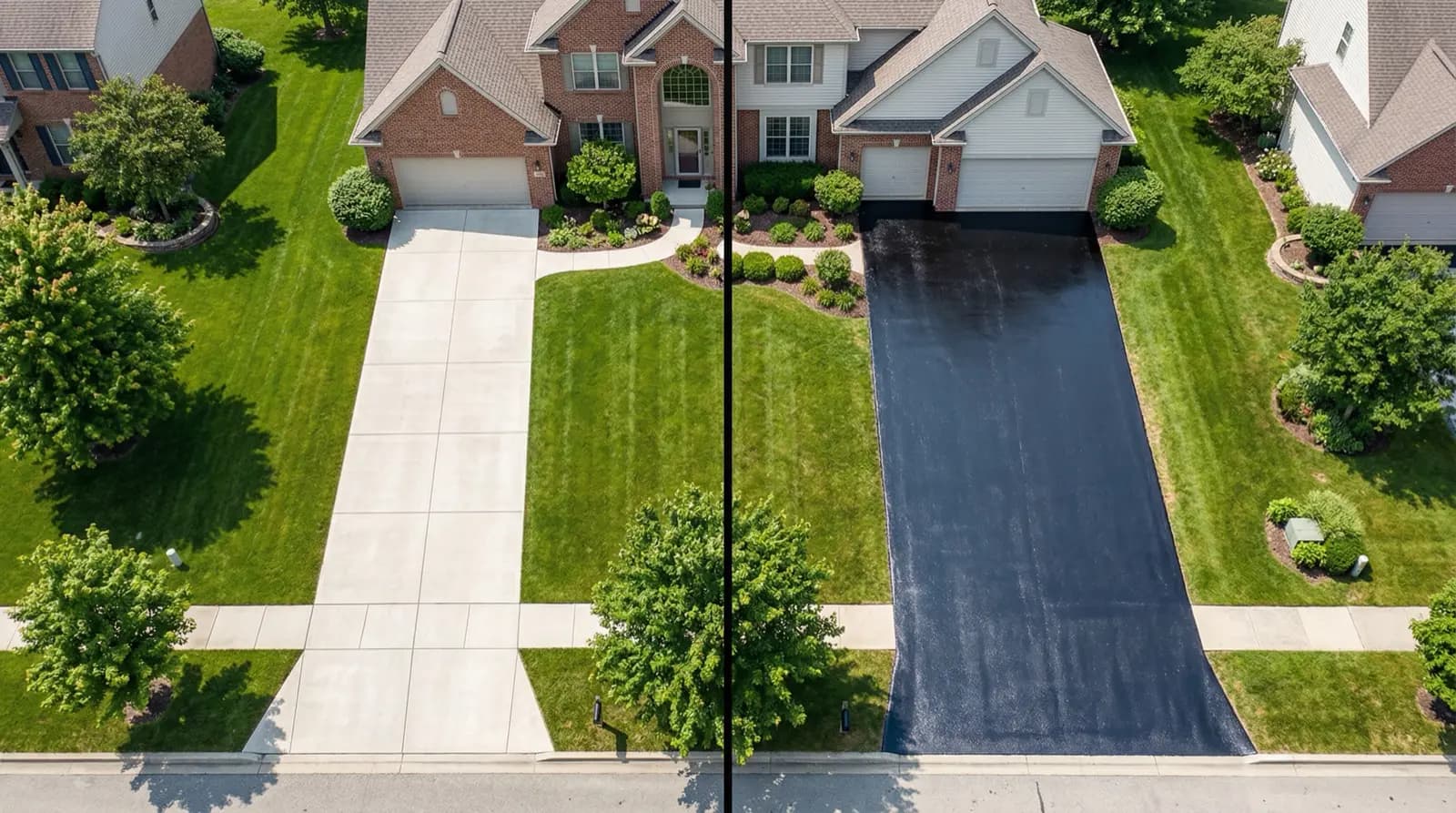
Every driveway contractor has an opinion about concrete vs asphalt, and that opinion almost always aligns with what they install. Concrete guys will tell you asphalt is cheap and ugly. Asphalt guys will tell you concrete cracks and costs too much.
The truth is less dramatic. Both are perfectly fine driveway materials, and the right choice depends on exactly three things: where you live, how much you want to spend, and how long you plan to own the house.
The Real Cost Difference
Let's start with money because that's what most people actually care about.
| Concrete | Asphalt | |
|---|---|---|
| Material + install (per sq ft) | $8-$15 | $7-$13 |
| 600 sq ft driveway | $4,800-$9,000 | $4,200-$7,800 |
| Annual maintenance cost | $0-$100 | $100-$300 |
| Reseal frequency | Never (optional seal) | Every 3-5 years |
| Reseal cost | $0.50-$1/sq ft (optional) | $0.25-$0.50/sq ft |
| Expected lifespan | 25-30+ years | 15-20 years |
| **Lifetime cost (30 years)** | **$5,000-$10,000** | **$7,000-$14,000** |
Sources: HomeAdvisor 2025 cost data, Angi contractor surveys
That lifetime cost line is what most people miss. Asphalt is cheaper upfront, but it needs resealing every 3-5 years and typically needs full replacement around the 15-20 year mark. Concrete costs more initially but lasts 25-30 years with minimal maintenance. Over 30 years, concrete is usually the cheaper option.
That said, if you're selling the house in 5-7 years, the upfront savings of asphalt might make more sense. You won't be around to pay for the resealing or the eventual replacement.
Climate Is the Real Decision Maker
Forget aesthetics for a moment. Climate should be the first filter.
Cold climates (USDA zones 3-5, roughly the northern third of the US):
Asphalt has a genuine advantage here. It's flexible — it expands and contracts with temperature changes without cracking. Concrete is rigid. In regions with heavy freeze-thaw cycles, concrete driveways develop cracks faster, especially if the base wasn't prepared perfectly.
Asphalt also handles deicing salt better. Salt accelerates the deterioration of concrete through a process called spalling — the surface flakes and pits. You'll see this on virtually every concrete driveway in the Midwest that's more than 10 years old. Asphalt isn't immune to salt damage, but it's significantly more resistant.
Hot climates (USDA zones 8-10, the South and Southwest):
Concrete wins here, and it's not close. Asphalt softens in extreme heat. In Phoenix, Dallas, or Atlanta, a black asphalt driveway on a 105°F day can become soft enough to show tire impressions from a parked car. You'll also notice the surface getting sticky underfoot.
Concrete stays stable regardless of temperature. It also reflects more sunlight, keeping the surface 10-15°F cooler than asphalt — a meaningful difference if you have kids or pets using the driveway.
Moderate climates (zones 6-7, mid-Atlantic, Pacific Northwest):
Either works fine. Your decision here comes down to budget and aesthetics.
The Maintenance Reality
Concrete maintenance: Almost nothing. Sweep it occasionally. Power wash it once a year if you want it to look fresh. You can apply a concrete sealer every 5-7 years to protect against staining, but it's optional — unsealed concrete will just develop a natural patina.
If concrete cracks (and it probably will eventually), repairs are visible but functional. You fill the crack with concrete caulk. It won't be invisible, but it won't affect performance.
Asphalt maintenance: More involved than most people expect. Fresh asphalt should be sealed 6-12 months after installation, then resealed every 3-5 years. Each resealing takes a full day (the driveway needs to be clear and dry) and costs $150-$300 for a standard driveway if you DIY, or $400-$700 if you hire someone.
Skip the sealing and the asphalt oxidizes — the surface fades from black to gray, becomes brittle, and develops cracks that let water penetrate the base layer. Once water gets under asphalt, the deterioration accelerates rapidly.
Appearance and Curb Appeal
This is subjective, but let's be honest: concrete looks better. Fresh asphalt looks clean and uniform, but within 2-3 years it fades to a dull gray unless you're diligent about resealing. Concrete maintains its appearance for decades.
Concrete also offers more design options. You can stamp it, stain it, expose the aggregate, or keep it plain. You can add decorative borders or score patterns into the surface. Asphalt is asphalt — there's one color (black) and one texture (smooth or slightly rough). Some companies offer colored asphalt sealer, but the results are mixed.
That said, asphalt has a certain clean, utilitarian look that suits some homes — particularly modern or industrial-styled properties. And in neighborhoods where every driveway is asphalt, a concrete driveway can look oddly formal.
The Environmental Angle
Asphalt is 100% recyclable. Old asphalt is commonly ground up and mixed into new asphalt, which is why asphalt contractors often offer to haul away the old material for free — it has resale value. The asphalt industry recycles about 99% of the material removed from driveways and roads, per the National Asphalt Pavement Association.
Concrete is also recyclable, though less commonly — it's typically crushed and used as base material under new installations. Production of Portland cement (the key ingredient in concrete) is a significant source of CO2 emissions, accounting for roughly 8% of global carbon output according to the International Energy Agency.
Neither option is particularly eco-friendly. If environmental impact is a priority, consider permeable pavers, which allow water to drain through the surface and reduce stormwater runoff.
Which Should You Pick?
Choose asphalt if: You live in a cold climate, want the lowest upfront cost, plan to sell within 5-7 years, or have a long rural driveway where concrete would be prohibitively expensive.
Choose concrete if: You live in a warm or moderate climate, want lower lifetime cost, plan to stay in the home long-term, care about curb appeal, or want design options beyond basic black.
Choose neither if: Your budget allows for interlocking pavers or natural stone, which outperform both concrete and asphalt in durability, appearance, and repairability — at a higher upfront cost.
See Both on Your Driveway
Still torn? Upload a photo of your driveway to DrivewAI and see concrete rendered directly on your property alongside other material options. Seeing the real contrast on your actual home is worth more than any comparison chart.
About the author
Noah James
Founder, DrivewAI
Noah James is the founder of DrivewAI, an AI home visualization platform that helps homeowners, contractors, and real estate agents preview renovations before committing. He built DrivewAI to close the gap between inspiration and execution in home improvement.
His writing focuses on practical renovation decision-making, material comparisons, and how AI visualization tools are changing the way people plan projects — from driveway replacements to full interior staging.
See your home transformed by AI
Upload a photo and get AI renderings across all styles. First one free.
Try DrivewAI Free